
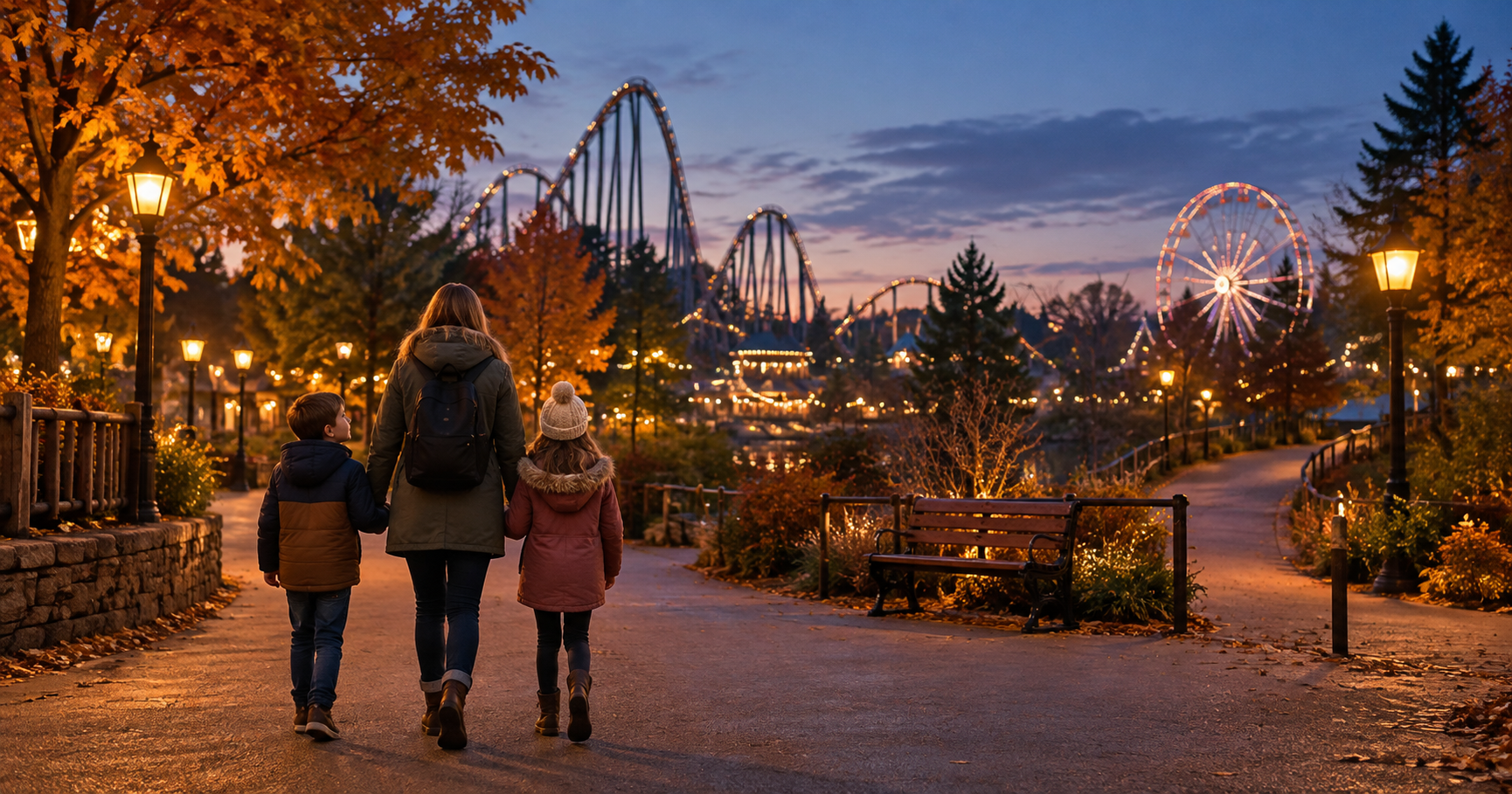
The same theme park can feel like three different destinations in one day.
In daylight, routes are easier to see and the environment may feel more predictable. At twilight, lights begin to glow, temperatures change and the atmosphere shifts. After dark, seasonal entertainment can become the main attraction—but music, lighting, crowds and uncertainty may become part of the experience too.
That does not make one time automatically better than another.
The useful question is: which version of the day gives your group the best chance of enjoying what matters most?
Begin with the experience you actually want
Autumn theme-park advertising naturally focuses on spectacle: illuminated rides, Halloween entertainment, late opening and the excitement of experiencing familiar attractions after sunset.
Before booking, separate the experience you want from the pressure to experience all of it.
Is the priority riding a favourite attraction? Enjoying seasonal decorations? Seeing the park illuminated? Spending time together? Trying one scare experience? Or giving a child their first theme-park day without pushing the visit beyond their comfortable limit?
Choose one or two anchors. Everything else can remain optional.
This makes it easier to leave early, skip an activity or change the plan without treating the day as a failure.
Daylight: greater visibility and fewer environmental changes
A daytime visit may work well for somebody who benefits from seeing routes, entrances, signs and other people clearly.
Natural light can make navigation feel more predictable. It is also easier to inspect an unfamiliar space, identify a quieter path or choose a meeting point that everybody will recognise.
Daylight does not guarantee a quiet park. The advantage is not necessarily lower demand; it is that fewer elements may be changing at once. An earlier departure can also preserve energy without adding the transition into darkness.
Twilight: beautiful, but full of transitions
Twilight can offer the most visually memorable part of an autumn visit. The sky changes, ride lighting becomes more visible and the park begins to feel different without being fully dark.
It is also a transition period. Temperature may fall, lights switch on and evening visitors may arrive while daytime visitors leave.
If change itself adds effort, build a pause into this part of the day. Eat before everybody is tired, add a warm layer before somebody becomes uncomfortable and identify where the group will stop while the environment changes around them.
After dark: atmosphere with a different sensory footprint
An after-dark event may be exactly what somebody wants. For another visitor, reduced visibility, theatrical lighting, amplified sound or unexpected interactions may make the park harder to navigate.
Read the event information rather than relying only on promotional footage. Check whether scare actors roam freely, whether particular areas can be avoided, which attractions or shows carry content warnings and whether the event offers quieter family-focused options.
Never assume that a standard daytime access plan will cover every seasonal experience. Opening hours, attraction availability, access arrangements and entertainment can change, so use the venue’s current event and accessibility pages before booking and check them again shortly before travelling.
Use a demand budget, not only a timetable
A traditional itinerary asks: “How many attractions can we fit in?”
A sensory-aware plan also asks: “What will each part of the day demand?”
Consider five forms of demand:
- Sensory: sound, light, smells, movement and crowds.
- Physical: walking, standing, temperature and the journey home.
- Cognitive: maps, instructions and changing plans.
- Social: staying together and asking for help.
- Emotional: anticipation, uncertainty or disappointment.
The aim is not to calculate a perfect score. It is to notice when several demanding elements are likely to arrive together—and protect some capacity for them.
Check the complete access journey
VisitEngland says travellers want detailed, factual accessibility information that helps them make their own decisions. Its current guidance reports that 95% of disabled people check accessibility before visiting somewhere new, while 77% have chosen not to visit a venue because they could not find the information they needed.
For a theme-park visit, check more than the ride itself:
- What does parking, security and entry involve?
- Is pre-registration required for an access scheme?
- How do ride-access arrangements work, and how many companions can use them?
- Are arrangements different for individual rides or seasonal attractions?
- Where are toilets, seating and quieter places?
- What happens if the group needs to split?
- What will leaving at the busiest time involve?
Verify important rules directly rather than depending on an old social-media post.
Give the group a splitting and regrouping plan
Agree three things before the first split:
- The exact regrouping point—not simply “near the ride”.
- Who remains with each child or person needing support.
- What happens if phones lose signal or battery.
Most importantly, do not make the person using an access arrangement responsible for coordinating everybody else. The group can share the practical work.
Pack for the change in the day
An autumn evening may require a different kit from an afternoon visit. Useful items might include a familiar warm layer, comfortable shoes, ear protection, a charged power bank, water, reliable snacks and any personal regulation tools already known to help.
Comfort is personal. Avoid testing an unfamiliar sensory product for the first time in the busiest part of the park.
Plan the ending before darkness falls
The final hour can contain the most decisions at the point when the group has the least energy left.
Decide what signals “enough” before somebody reaches complete overwhelm. Identify the route out, the meeting point and whether the return journey depends on a fixed train, bus or collection time.
Leaving while the day still feels successful is not wasting the ticket.
It is protecting the memory you came to make.
Choose the version of the park that works for you
A sensory-aware theme-park visit is not necessarily quieter, shorter or less adventurous. It is a visit designed with enough information and flexibility for real people.
Choose daylight for visibility and predictability. Choose twilight for atmosphere with a planned pause. Choose after dark when the spectacle is worth the additional sensory demand.
There is no prize for enduring the most intense version of the day.
The best choice is the one that leaves enough room to experience what you came for.
Explore Alchemy Souls Travel’s neuroinclusive travel guidance and sensory-friendly packing list for more practical ways to plan travel around comfort, energy and real life.
Final article word count: 1,083 words.
6. Sources and internal links
Verified external sources
- VisitEngland: Providing accessibility information — updated 7 April 2026; supports the accessibility-information statistics and the recommendation to use detailed, factual access information.
- Alton Towers: Scarefest — use for live event dates, opening information and warnings before adding any venue-specific detail.
- Alton Towers: Accessibility — use for current access arrangements before publication or travel.
- Access Card: Find a provider — current provider directory for checking participating attractions and symbols.
All statements comparing daylight, twilight and darkness are editorial planning guidance, not claims that every venue has the same environment or access arrangements.
Leave a Reply